
Addiction Medicine Fellowship
Didactics & Scholarly Activities
Formal Teaching
Fellows participate in a structured series of conferencesdidactics that build expertise in addiction medicine while developing skills in patient-centered communication, trauma-informed care, structural competency, and the critical appraisal and application of emerging research to clinical care and policy: and didactics designed to build knowledge, critical thinking, and presentation skills, including:
- A one-week orientation boot camp during the first week of fellowship
- A weekly Chief’s Conference covering key addiction-related topics including a series on motivational interviewing
- A monthly Addiction Medicine/Addiction Psychiatry Journal Club
- A monthly Addiction Medicine/Addiction Psychiatry Case Conference or Didactic Session
- Weekly national virtual didactics hosted by the American College of Academic Addiction Medicine (ACAAM)
Each fellow presents at least once at both a Journal Club and Case Conference and completes a faculty-mentored quality improvement (QI) project. Recent QI projects have addressed topics such as:
- Universal naloxone prescribing on discharge
- Implementation of harm reduction services in primary care
- Inpatient recovery support groups
- Creation of a database to track outcomes for hospitalized patients with substance use disorders
- Improving naloxone prescribing among pediatric palliative care clinicians
Advocacy Curriculum and Project
With faculty mentorship, fellows complete a longitudinal advocacy project that develops practical skills in policy and systems change. Fellows work individually or collectively to identify a policy issue that aligns with their interests and develop and implement an advocacy strategy through conducting a policy analysis, mapping key decision-makers, and engaging with community partners and policymakers.
Scholarly and Community Engagement
Fellows are encouraged to participate in local and national conferences and community events that foster professional development, networking, and scholarly dissemination, including:
- Pittsburgh Recovery Walk (September)
- AMERSA Annual Conference (November)
- Pittsburgh Addiction Medicine Conference (December)
- ASAM Annual Conference (April)
- ACAAM Fellow Lightning Rounds (May)
- College on Problems of Drug Dependence (CPDD) (June)
For more information, please contact:
Tiffany Thomas
Addiction Medicine Program Coordinator
dixont2@upmc.edu

Dr. Maggie Shang (left) presenting her fellowship QI project with mentor Dr. Raagini Jawa (right) at AMERSA.
- Internal Medicine residency motivational interviewing curriculum
- Pediatrics residency SBIRT curriculum
- Medical student workshops on topics like harm reduction
Our program also supports fellows to apply for national scholarly programs and awards:
ASAM Ruth Fox Scholarship Recipients
- Reed Nerness MD (2026)
- Cynthia Pathmathasan MD (2025)
- Ilana Hull MD MSc (2022)
- Kento Sonoda MD (2022)
Reach 2.0 Program
- Cynthia Pathmathasan MD, 2026-2027 Neer Peers
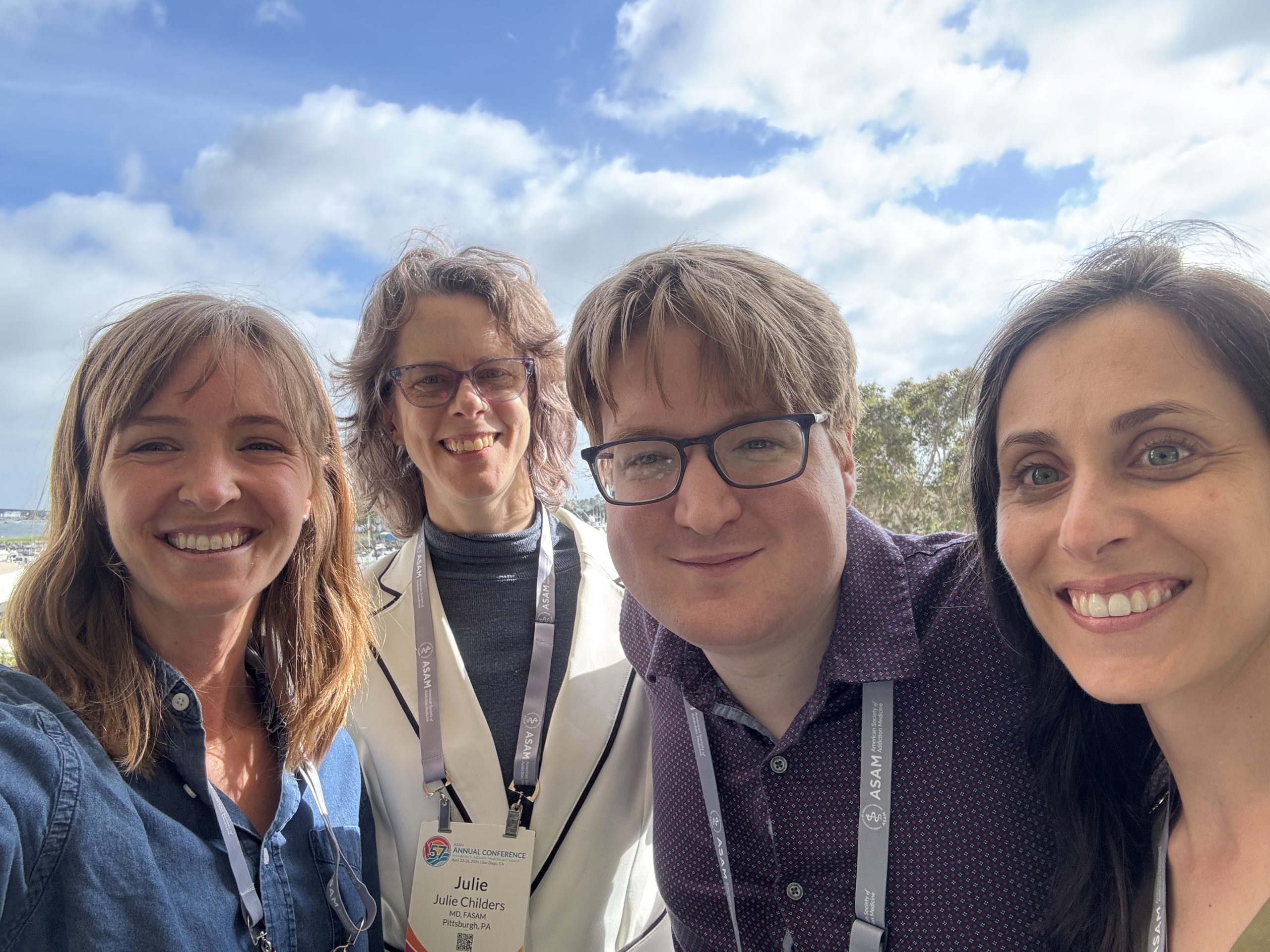
Addiction Medicine fellows with faculty at ASAM 2026 Annual Conference in San Diego (pictured left to right: Drs. Reed Nerness, Julie Childers, Jonathan Weinhold, Andrea Gaspar)