
Programs and Laboratories
Antibiotic Management Program
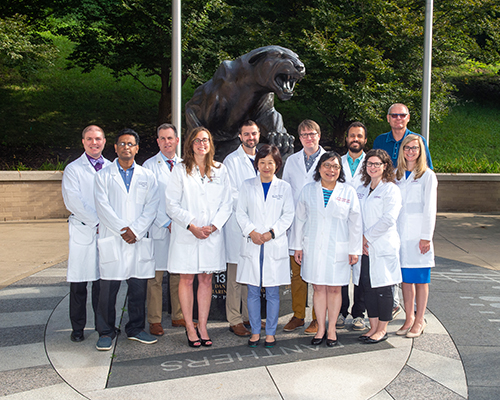 Directed by Drs. Ryan Shields, PharmD, MS, and M. Hong Nguyen, MD, the Antibiotic Management Program (AMP) is a joint initiative of the Division of Infectious Diseases and the Department of Pharmacy and Therapeutics. Staffed by five infectious diseases physicians, five ID pharmacists, seven ID medical fellows, and one ID pharmacy fellow, the program’s mission is to improve patient outcomes by ensuring timely, appropriate antimicrobial therapy while minimizing unnecessary use. This approach helps prevent superinfections, such as Clostridium difficile, and combats antimicrobial resistance.
AMP achieves its goals through a stewardship phone and pager system that requires prior approval for select antimicrobials, coupled with prospective follow-up of existing orders to confirm appropriate selection, dosing, and duration. Stewardship efficiency is further enhanced by TheraDoc®, a decision-support software that enables real-time identification of intervention opportunities. Education is also a key priority: AMP publishes an institutional Antibiotic Guide (both electronic and hardcopy) to support formulary-based prescribing, contributes to the ID fellows’ and residents’ educational series, and regularly presents at Infectious Diseases and Medicine Grand Rounds.
In response to the global antimicrobial resistance crisis, AMP collaborates with the XDR Pathogen Laboratory and the Center for Innovative Antimicrobial Therapy (CIAT) to evaluate new agents and optimize treatment for patients with extensively or pan-drug resistant infections. AMP also partners closely with the clinical microbiology laboratory, most recently establishing a Diagnostic Management Team (DMT) to assess and implement molecular-based assays for rapid pathogen detection. Results are communicated to clinicians in real time, with AMP providing guidance on therapeutic selection and optimization at the bedside.
For more information, please contact Dr. Ryan Shields (shieldsrk@upmc.edu) or Dr. M. Hong Nguyen (nguyenh@dom.pitt.edu).
UPMC Extensive Drug-Resistant Pathogen Laboratory
Infections caused by Gram-negative bacteria resistant to nearly all antibiotic classes have risen sharply worldwide, a crisis compounded by the slowing pace of new antibiotic development. These “superbug” infections pose particular challenges at UPMC and other centers caring for large numbers of immunosuppressed patients and those at high risk for complicated infections.
The mission of the UPMC XDR (Extensively Drug-Resistant) Pathogen Laboratory is to define optimal antimicrobial regimens against XDR pathogens recovered from patients in collaboration with the Antimicrobial Management Program (AMP) and clinical services to improve outcomes. The lab follows a systematic, stepwise approach: identifying active antimicrobial agents and combinations through in vitro time-kill assays; determining genetic resistance mechanisms via molecular techniques such as targeted and whole-genome sequencing; correlating laboratory activity with resistance markers to predict treatment responses; and applying these data to design patient-specific regimens. Working closely with AMP, the lab ensures that optimal drugs and dosing strategies are used in clinical care. More recently, the XDR Lab has expanded to prospectively test investigational agents in Phase 2 and 3 trials, positioning UPMC to incorporate these therapies rapidly once FDA-approved.
Since its inception, the XDR Pathogen Lab has been recognized internationally as a leader in the management of highly resistant Gram-negative infections. Notable achievements include: demonstrating that a carbapenem–colistin combination was the most active regimen against XDR-Acinetobacter baumannii, reducing mortality among transplant recipients from >90% to <20%; developing an institution-specific treatment algorithm for carbapenem-resistant Klebsiella pneumoniae(CRKP) that has lowered mortality, shortened hospital stays, and reduced costs; and being the first group worldwide to detect real-time emergence of CRKP resistance to the new antibiotic ceftazidime–avibactam, uncover the underlying genetic mechanisms, and show that these changes restored carbapenem susceptibility. These findings have led to a revised UPMC treatment algorithm for CRKP, and future work will evaluate its impact on outcomes, length of stay, and cost savings.
For more information on the XDR Pathogen Laboratory, please contact Dr. M. Hong Nguyen (nguyenh@dom.pitt.edu).
Microbial Genomic Epidemiology Laboratory
The mission of the Microbial Genomic Epidemiology Laboratory (MiGEL), part of the Infectious Diseases Epidemiology Research Unit, is to advance microbial genomic epidemiologic investigations of hospital- and community-acquired bacterial infections. Using genomic, phylogenetic, and bioinformatic approaches, MiGEL identifies genetic relationships among bacterial pathogens that pose serious public health threats and supports UPMC Infection Prevention by detecting hospital outbreaks.
Current projects include developing, validating, and implementing bacterial whole-genome sequencing (WGS) for outbreak detection; creating bioinformatic tools for rapid interpretation of WGS data; integrating sequencing results with electronic health records to enable real-time detection of hospital-associated transmission; and investigating microbiome profiles from peri-rectal surveillance swabs to predict infection risk and track hospital-associated bacteria. MiGEL also conducts comparative genomic and phylogenetic studies of global Neisseria meningitidis populations, work that has advanced understanding of population structure, clonal emergence, and worldwide spread.
In addition to its research, MiGEL provides training in molecular epidemiology for master’s and doctoral students, infectious diseases fellows, and visiting international scientists.
For more information, please contact Dr. Lee Harrison (lharriso@edc.pitt.edu).
VA Pittsburgh Healthcare System (VAPHS)
The Infectious Diseases (ID) Division at the VA Pittsburgh Healthcare System (VAPHS) provides expert clinical care, leads Infection Prevention (IP) and Antimicrobial Stewardship (ASP) programs, and conducts research across a network of hospitals and clinics serving veterans in western Pennsylvania and parts of Ohio, West Virginia, and New York.
Clinical services include inpatient consultations at Pittsburgh hospitals and the long-term care facility, transplant ID management, outpatient clinics (including comprehensive HIV care), telemedicine consultations for veterans outside Pittsburgh, and home antibiotic therapy oversight. IP and ASP teams manage both facility-based and system-wide programs to ensure high-quality, evidence-based care.
Research funded by the VA and NIH focuses on antifungal and antibacterial resistance, fungal pathogenesis, and stewardship strategies such as tele-stewardship and interventions in long-term care. Additional clinical and translational studies address molecular and hospital epidemiology, antimicrobial resistance, infection prevention practices, and treatment outcomes across a range of infections.
For more information about VAPHS specialty services, visit VA Pittsburgh Health Care – Specialty Care.
Surgical Infectious Diseases Services
The Surgical Infectious Diseases Service provides expertise in complicated surgical infections and continuity of care for patients requiring long-term follow-up. The focus is on patients with neurosurgical, orthopedic, cardiothoracic and ENT infections.
For more information, please contact Dr. Karin Byers (byerke@upmc.edu)