
Fellowship Tracks
The Cardiovascular Fellowship Program at the University of Pittsburgh offers three distinct training pathways designed to prepare fellows for leadership in academic, clinical, and research careers: the general cardiology track, a three-year program offering comprehensive training across all areas of cardiovascular medicine; the clinician-educator track, a four-year program combining advanced clinical training with formal education in medical teaching and curriculum design; and the physician-scientist track, a four- to five-year program focused on developing independent investigators through mentored research and structured scientific training. Each track provides individualized mentorship, abundant scholarly opportunities, and access to world-class resources across the Heart and Vascular Institute (HVI) and UPMC system.
General Cardiology Track
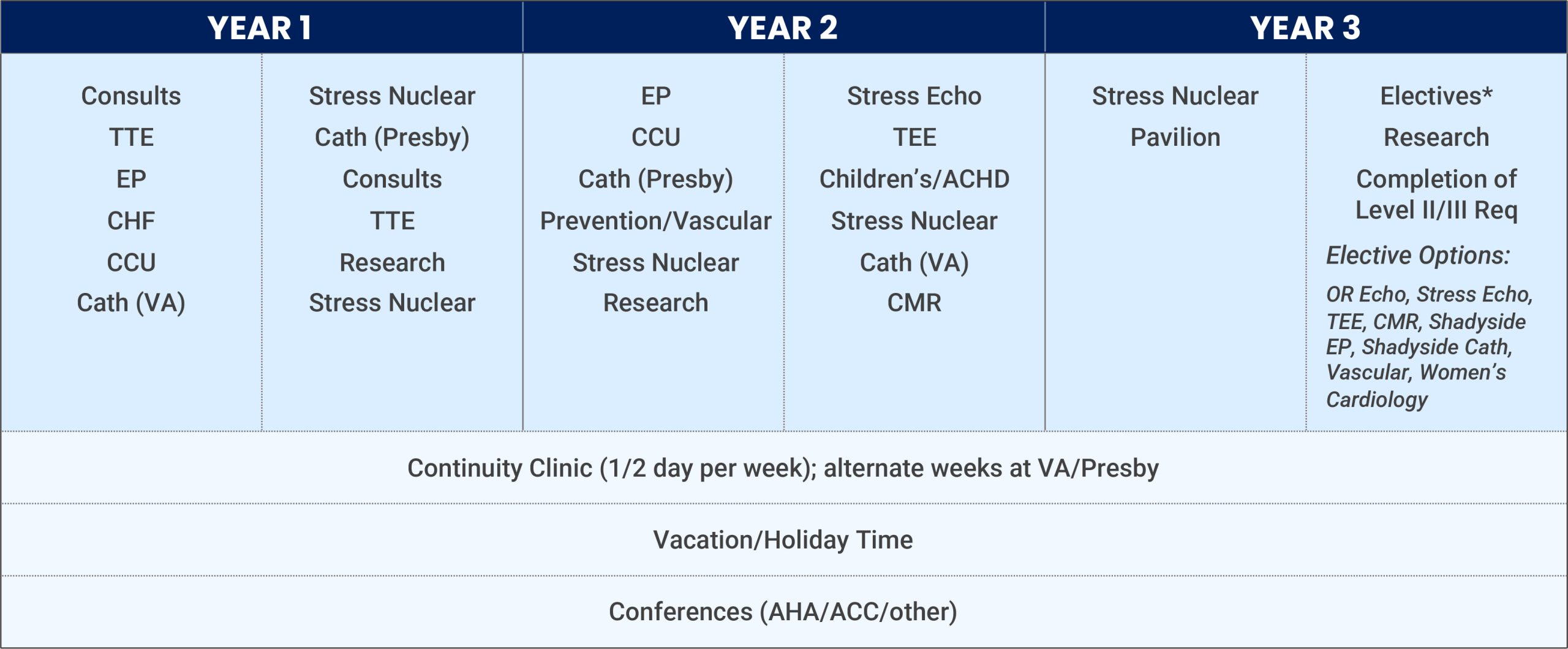
Our three-year general cardiology fellowship trains future leaders in all aspects of cardiovascular medicine. The program meets all ABIM and ACGME requirements, preparing fellows to sit for the cardiovascular boards after their third year.
During the third year, fellows tailor their experience to align with their career goals, whether that means focusing on research, pursuing additional certification (Level II/III) in subspecialty areas, or expanding expertise in clinical practice.
Throughout training, fellows receive close mentorship from experienced and engaged faculty within the HVI and across the UPMC system, ensuring a strong foundation in both clinical and academic cardiology.
Clinician-Educator Track
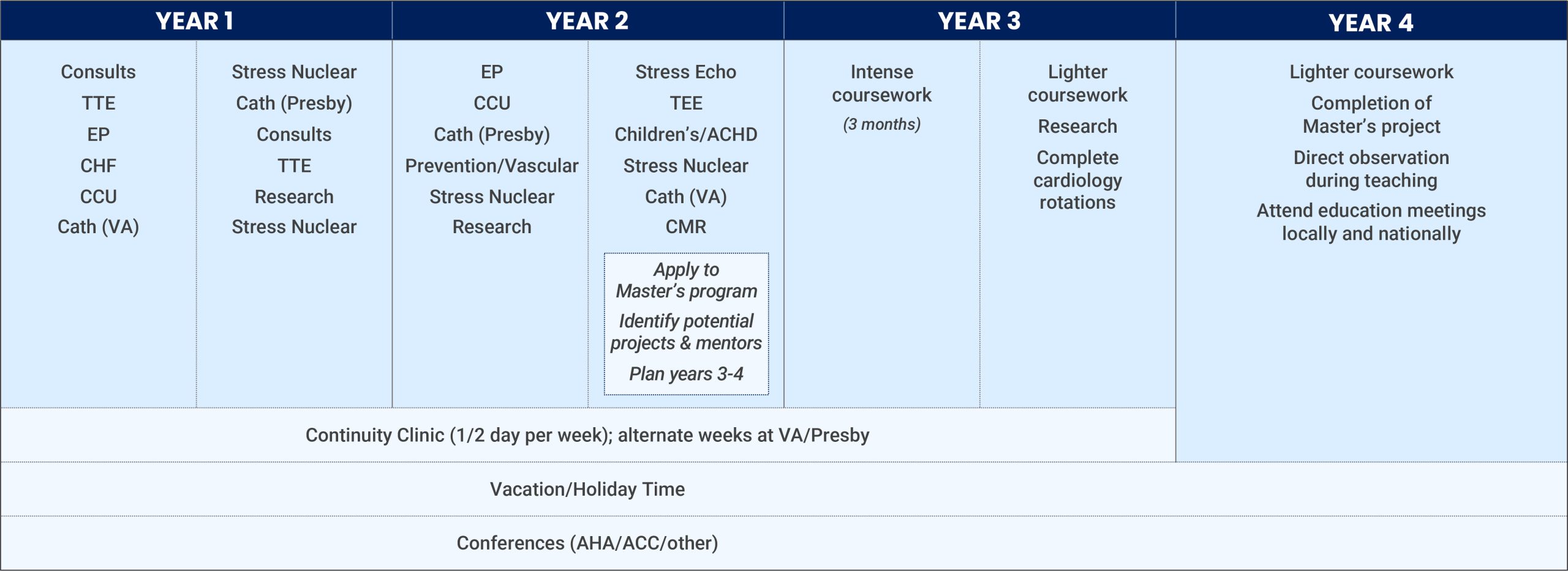
The four-year Clinician Educator Track is designed for fellows interested in developing as medical educators and academic leaders. Participants complete a Master of Science in Medical Education through the University of Pittsburgh’s Institute for Clinical Research Education while continuing their cardiology training.
Fellows complete the majority of their clinical rotations during the first two years. In years three and four, they engage in master’s coursework, hands-on educational experiences alongside senior educators, and active participation in teaching and educational committees. Each fellow also designs and implements an educational scholarship project, gaining valuable experience in curriculum development, assessment, and educational research.
Cardiology Physician Scientist Track
The Physician Scientist Track is a four- to five-year fellowship designed for individuals pursuing a career as an independent investigator in cardiovascular research. After two years of intensive clinical training, fellows dedicate the remaining years to mentored research and scholarly development.
Fellows identify faculty mentors early in training and are expected to present their findings at national meetings and publish first-author manuscripts. Progress is closely monitored by a Research Committee, with fellows meeting three to four times per year and regularly presenting their work at weekly Research in Progress Conferences. In addition, participants join monthly grant writing workshops to prepare competitive applications for Career Development Awards (NIH, AHA, VA) and other funding mechanisms.
Many fellows in this track benefit from two to three years of structured research funding support through the postdoctoral Training Program in Imaging Sciences in Translational Cardiovascular Research (T32) (link to T32 page), an innovative program that develops scientists who can bridge imaging technology and biomedical research through a co-mentorship model, structured milestones, and specialized coursework. The T32 emphasizes translational and multimodality imaging competencies, spanning molecular to population-level science, while supporting trainee growth through evidence-based mentorship, resilience resources, and emerging training in artificial intelligence and data-driven discovery.
Key Components of Physician Scientist Training
- Fellows Research Career Retreat: Each February, first-year fellows attend an off-site retreat hosted by Cardiology and the Vascular Medicine Institute, featuring presentations by research faculty and opportunities to identify mentors and projects.
- Research in Progress Conferences: Weekly meetings featuring fellow-led presentations and open discussion, helping trainees refine presentation skills and receive constructive feedback from senior researchers.
- Fundamentals of Bench Research (CLRES 2700): A two-week intensive course introducing the theory and practice of bench research through lectures and hands-on laboratory sessions.
- Cardiology Fellow Research Grant: Up to $10,000 per year in competitive funding is available to support research projects during training.
- Semiannual Reviews: Formal evaluations every six months assess progress toward research and professional milestones, ensuring strong mentorship and continued growth.

For more information, please contact:
Denise Goppman
Fellowship Coordinator
412-647-3429
goppmanda@upmc.edu